Unlock IIoT Scalability: Edge Computing Architecture for Industrial Applications
The convergence of industrial operations with advanced digital technologies has ushered in the era of the Industrial Internet of Things (IIoT). This transformative shift promises unprecedented efficiency and insights, yet it simultaneously presents immense challenges, particularly concerning data management and system scalability.
Edge computing emerges as a pivotal architectural paradigm, strategically positioning computational resources closer to the data source within industrial environments. This approach is fundamental for addressing the unique demands of IIoT, ensuring that vast quantities of sensor data can be processed efficiently and securely at scale.
Understanding the Industrial Internet of Things (IIoT) Landscape
Industrial IoT refers to the network of interconnected sensors, instruments, and other devices connected with computers’ industrial applications. Its primary goal is to enhance manufacturing and industrial processes through automation, predictive maintenance, and real-time operational visibility.
However, the sheer volume, velocity, and variety of data generated by IIoT devices can quickly overwhelm traditional cloud-centric infrastructures. Latency-sensitive applications, stringent security requirements, and bandwidth limitations often necessitate processing data closer to where it originates, which is precisely where edge computing delivers significant value.
The Fundamental Role of Edge Computing
Edge computing is a distributed computing paradigm that brings computation and data storage closer to the sources of data. This contrasts with traditional cloud computing, where data is typically sent to a centralized data center for processing.
In an IIoT context, the “edge” can refer to devices on the factory floor, within machinery, or at a remote operational site. By processing data at the edge, organizations can achieve faster response times, reduce network traffic, and maintain operations even with intermittent cloud connectivity.
Why Edge Computing is Critical for IIoT Scalability
Scaling IIoT deployments involves managing an increasing number of devices, data streams, and applications without compromising performance or reliability. Edge computing offers several crucial advantages that directly support this scalability.
Firstly, it significantly reduces network latency by enabling real-time data processing directly at the source, which is vital for critical industrial control systems and immediate decision-making. Secondly, processing data locally dramatically lowers the amount of data transmitted to the cloud, thereby conserving bandwidth and reducing cloud storage and processing costs.
Furthermore, edge computing enhances data security and privacy by allowing sensitive operational data to remain within the local industrial network, minimizing exposure to external threats. It also provides operational continuity, ensuring that vital processes can function autonomously even if the central cloud connection is temporarily lost.
Key Components of a Robust IIoT Edge Architecture
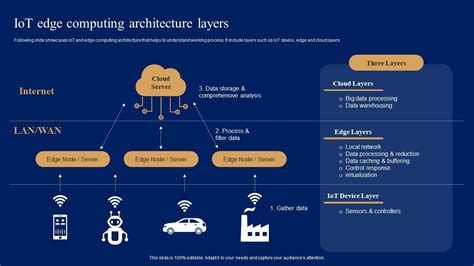
A well-designed edge computing architecture for IIoT comprises several interconnected layers, each with specific functions. These layers work in concert to collect, process, analyze, and act upon industrial data.
At the lowest level are the **Edge Devices**, which include a wide array of sensors, actuators, cameras, and embedded controllers directly integrated into machinery and industrial processes. These devices are responsible for collecting raw operational data and executing commands.
Next are **Edge Gateways**, which serve as aggregation points for data from multiple edge devices. These gateways perform initial data filtering, protocol translation, and secure communication with higher architectural layers, bridging the gap between operational technology (OT) and information technology (IT) networks.
Further up the hierarchy, **Edge Servers** or micro data centers provide more substantial computational power and storage capabilities closer to the operational site. These servers enable local analytics, machine learning model inference, and complex data processing that requires more resources than what edge gateways can offer.
Finally, **Cloud Integration** remains a critical component, providing capabilities for global data aggregation, long-term storage, enterprise-wide analytics, and centralized management of distributed edge deployments. The cloud acts as an orchestrator, delivering updates, models, and overall governance to the edge infrastructure.
Architectural Topologies and Deployment Models
Various architectural models can be employed to deploy edge computing within IIoT environments, depending on the scale, complexity, and specific requirements of the industrial application. A common approach is a **Hierarchical Edge Architecture**, which organizes computing resources into tiers.
This hierarchy typically ranges from device-level edge processing, through gateways and local servers, up to regional data centers and the central cloud. This tiered approach allows for flexible data routing and processing based on criticality and resource availability, ensuring optimal performance and resource utilization across the entire system.
Another model is the **Distributed Edge-to-Cloud Continuum**, which emphasizes seamless connectivity and workload mobility across all layers. This continuum treats edge devices, local servers, and the cloud as a unified, fluid computing environment, enabling dynamic allocation of tasks.
This model is particularly advantageous for applications requiring flexible resource scaling and resilient operations across diverse geographical locations. Organizations can thus select a topology that best aligns with their operational structure and data processing needs.
Implementing Edge Computing for Scalable IIoT
Successful implementation of an edge computing architecture for IIoT scalability requires careful planning and execution across several key areas. Choosing the right hardware and software components that are rugged enough for industrial environments and capable of handling demanding workloads is paramount.
Moreover, robust network design and connectivity solutions are essential to ensure reliable data flow between edge devices, gateways, and the cloud, often leveraging technologies like 5G or industrial Ethernet. Effective data management and orchestration platforms are also crucial for managing data lifecycles and deploying applications across distributed edge nodes.
Finally, a comprehensive security strategy is non-negotiable, encompassing device authentication, data encryption, access control, and continuous monitoring at every point of the edge infrastructure. Addressing these aspects systematically ensures a resilient and scalable IIoT deployment.
Benefits of a Scalable Edge-IIoT System
Adopting a scalable edge computing architecture yields significant benefits for industrial enterprises embarking on digital transformation journeys. It leads to improved operational efficiency by providing real-time insights that optimize production processes and resource allocation.
Furthermore, faster decision-making is enabled through immediate data analysis, allowing for proactive responses to operational anomalies or opportunities. Reduced costs are realized by minimizing reliance on expensive cloud bandwidth and storage, while enhanced system resilience ensures business continuity even in challenging network conditions.
Challenges in Edge IIoT Adoption
Despite its numerous advantages, the adoption of edge computing in IIoT also presents several challenges that organizations must navigate. The inherent complexity of deploying and managing distributed computing resources across varied industrial environments can be substantial.
Furthermore, a lack of universal standardization and interoperability among different vendor solutions can hinder seamless integration and scalability. Securing a multitude of distributed edge devices and gateways against evolving cyber threats also demands sophisticated strategies and continuous vigilance.
Future Trends in Edge-IIoT
The future of edge computing for IIoT is poised for further innovation and deeper integration with emerging technologies. The deployment of Artificial Intelligence (AI) and Machine Learning (ML) models directly at the edge will become increasingly prevalent, enabling more autonomous and intelligent industrial operations.
Additionally, the widespread rollout of 5G networks will significantly enhance edge connectivity, providing ultra-low latency and high bandwidth that will unlock new possibilities for real-time applications and massive device deployments. Serverless edge computing is also gaining traction, simplifying application deployment and scaling at the edge by abstracting underlying infrastructure complexities.
Conclusion
Edge computing is not merely an enhancement but a fundamental requirement for achieving true scalability and efficiency within the Industrial Internet of Things. By bringing processing power closer to the data source, it effectively addresses critical challenges related to latency, bandwidth, security, and operational continuity.
Enterprises that strategically adopt and implement robust edge computing architectures will be better positioned to harness the full potential of their IIoT initiatives, driving innovation and maintaining a competitive edge in the rapidly evolving industrial landscape. This paradigm shift is crucial for transforming raw data into actionable intelligence, empowering the next generation of smart factories and intelligent operations.
Frequently Asked Questions (FAQ)
What is Edge Computing in the context of IIoT?
Edge Computing in IIoT refers to a distributed computing paradigm where data processing and storage are performed closer to the industrial data sources, such as sensors and machines on a factory floor. This local processing reduces reliance on centralized cloud servers for immediate operational tasks.
How does Edge Computing improve IIoT scalability?
Edge Computing improves IIoT scalability by reducing network bandwidth usage, lowering data transmission costs, and decreasing latency for real-time operations. It enables distributed processing, allowing more devices and data streams to be managed efficiently without overwhelming central systems.
What are the main components of an Edge IIoT architecture?
The main components typically include Edge Devices (sensors, actuators), Edge Gateways (data aggregation, protocol conversion), Edge Servers (local data processing and analytics), and Cloud Integration (for centralized management, long-term storage, and global analytics).
What are the benefits of using Edge Computing for industrial applications?
Key benefits include improved operational efficiency, faster decision-making due to real-time data analysis, reduced cloud costs, enhanced data security and privacy by keeping sensitive data local, and increased system resilience by allowing operations to continue even without cloud connectivity.
What challenges does Edge Computing address in IIoT?
Edge Computing addresses challenges such as high latency for critical industrial control, excessive bandwidth consumption from sending all raw data to the cloud, data security and privacy concerns, and the need for operational continuity in environments with unreliable network connections.